Analyzing customer interviews
Can't believe that it's already two weeks since I published my first post! Since then, something has bugged me to write another one, but I haven't found the time or inspiration. I felt that I don't have anything to share nor done anything worth writing about. At some point, I decided to put a little bit more effort into it and just gave it a try - and that turned out to be a wonderful decision: I quickly noticed that there indeed things to reflect upon. So here we go.
My significant other and I are currently working on building a business together. In the last couple of weeks, she has led 15 interviews with potential customers to get a better understanding of their motivations and problems. As a result, we had many pages of hand-written notes, which promised to make our next steps very clear. While leading the interviews, we didn't think much about these notes, but when we sat down together to analyze them, we were overwhelmed: We were not able to extract any useful data from all of that information! We were crushed, our mood went down... She spent so many hours talking to people, but we were not able to make anything out of it? We have adopted an analytical, iterative, step-by-step method to building a business because it promises continuous progress. When we got stuck anyways, we quickly got frustrated and started to act emotionally: My significant other questioned the method for being too dry and boring. I was annoyed by the way she led the interviews because I now had to deal with the result of that. We both felt the urge to throw everything away and do something else. Between taking care of our child, earning our living and handling whatever else life throws at us, we don't have a lot of time to work on this, which further heated up the situation. We managed to acknowledge the situation and agreed on taking a break.
A couple of hours later, I sat down alone and came up with the idea of building a spreadsheet of problems and rating them. I then presented the approach to my partner and asked her for help with completing it. And boom, we started to recognize patterns in our interviews!
Here's what we did in detail.
- We went through the first interview, listed each problem as a row in a spreadsheet and gave it a score. We decided on a score from 1 to 6 with 1 meaning that it was just a slight annoyance and a 6 indicating that the person is actively investing (time, effort or money) in getting rid of the problem. We regularly reminded ourselves to stay with our customer's perspectives instead of rating their problem from our point of view.
- We kept adding a new column for each interview. If we stumbled upon new problems, we went back to give the previous ones a score too. This way, we got access to information that was not noted down.
- For each problem, we summed up the scores to find out how relevant they were all together. That's when things started to become a lot more accessible.
- We noticed that each problem by itself would be too small for our product, so we started to group problems to get a bigger picture of things.
- We found a way to score groups. At first, we just summed the score of all problems for a customer, but that turned out to skew results: Of course, a lot of problems would relate with each other, so groups with the most problems would be overrepresented. To get rid of that, we decided to simply use the most severe score from all of the group's problems.
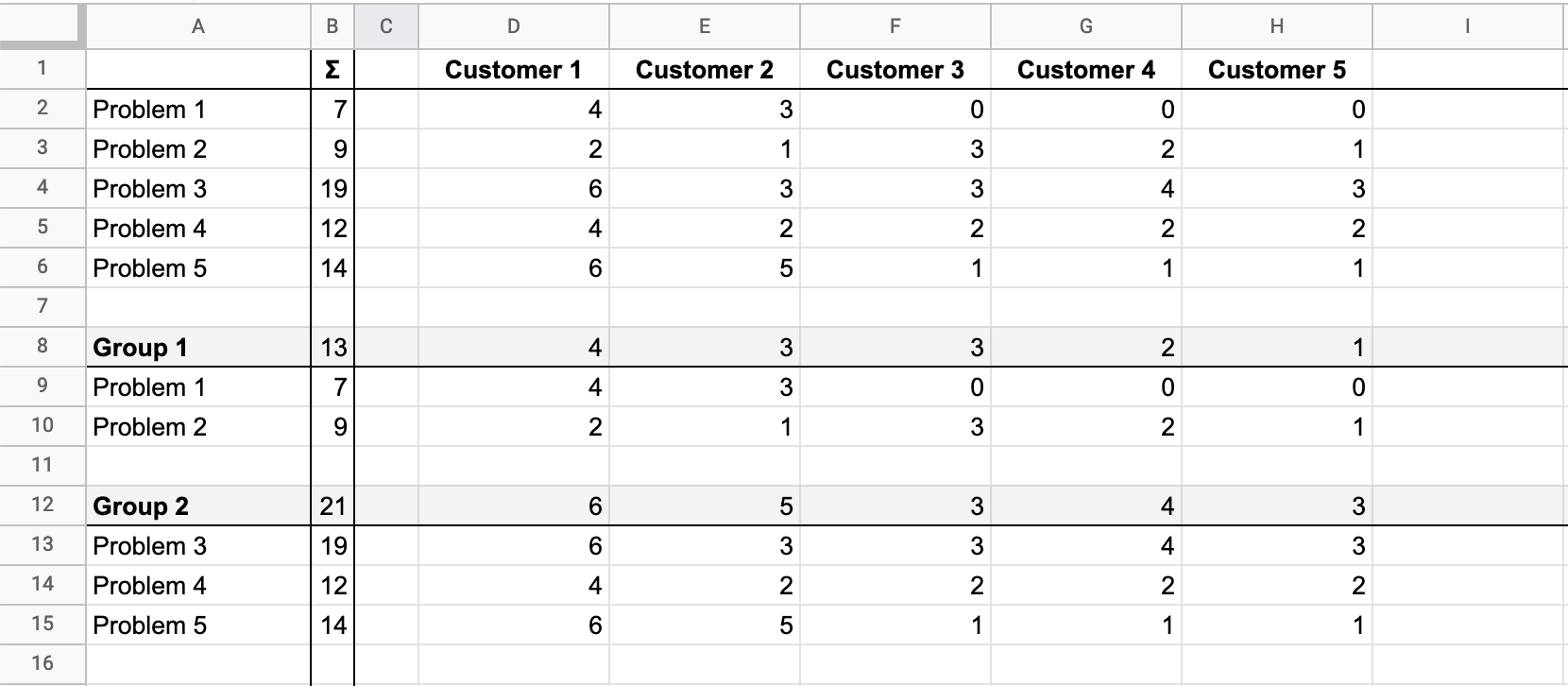
While there are probably other ways to build a score that's even more meaningful, we were quite satisfied with the result. We were able to get past our initial frustration and turn things around!
So what's the lesson here?
Here's what I keep thinking about: We were able to extract extremely valuable information from our interviews, but at some point we were close to throwing our work into the trash can. Really close. So how can we avoid this in the future?
I'm not sure. If we don't enjoy our work anymore, we'll take a step back to do something creative and fun to charge our batteries. But I'm wondering if there are others, so I'll be looking for methods to take care of a group's energy levels. I'm certain there's a myriad of books and resources about this topic. But until then: take a break and do something fun. The result will be amazing.